Kimi’s Rapid Rise in AI Funding
This weekend, the most notable news in China’s artificial intelligence sector is Kimi’s new round of financing. This large model company completed three rounds of financing in less than three months, with its valuation skyrocketing from $4.3 billion to $18 billion (approximately 120 billion RMB), setting a record for continuous financing amounts in the domestic large model field in recent years.
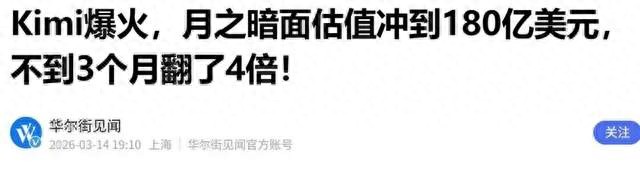
Behind this astonishing speed lies a wealth of information. Among China’s mainstream large model companies, Kimi has been the most difficult to track due to its non-public status and minimal information disclosure. While competitors like Zhipu and MiniMax have their operational details under the spotlight due to their IPO processes, Kimi’s movements rely more on word of mouth and professional evaluations within the industry.
This low transparency makes this round of intensive financing even more worthy of scrutiny. Understanding the logic behind “three rounds of financing in three months” not only clarifies the company itself but also helps grasp the true competitive landscape of large models in China and globally.
01 Cognitive Leadership Brings Capability Advantages
China has never lacked large model companies, but it lacks those that are truly cognitively advanced. Kimi’s uniqueness can be traced back to a single name.
In September 2025, Kimi began gray testing a new product called “OK Computer” (later renamed Agent). This name, derived from Radiohead’s classic album, carries a touch of artistic flair while encapsulating the company’s deepest strategic judgment: while many peers are still competing on context length and leaderboard scores in the chatbot arena, Kimi has already begun exploring another path—enabling AI to perform real-world tasks.
This shift in product form reflects a fundamentally different strategic judgment. While the industry debates whether large models can understand complex instructions, Kimi has realized that language models are merely an interface; the real value lies in the model’s transition from “dialogue” to “execution.” The core of this judgment is an early insight into the trends of “Computer Use” and Agents.
Kimi’s President, Zhang Yutong, elaborated on this strategy during a talk at Tsinghua University: “Our goal is to make Kimi everyone’s full-stack assistant.” This goal is rooted in Kimi’s path since its inception: focusing on the logic layer, the Agent layer, and high-value tasks that require long-term planning and complex tool usage.
This cognitive leadership ultimately manifests in technical achievements. On the SWE-Bench Verified benchmark, which measures software engineering capabilities, Kimi K2 achieved a score of 71.3%, surpassing most open-source and closed-source models. In November 2025, the Kimi K2 Thinking model was released, trained on the concept of “model as Agent,” natively mastering the ability to “think while using tools,” achieving a score of 44.9% in the “Humanity’s Last Exam” and reaching SOTA levels in several benchmark tests like autonomous web browsing (BrowseComp).
By January 2026, when Kimi K2.5 was released, the Agent capabilities had evolved to a “cluster” level. The K2.5 Agent cluster model can dispatch up to 100 avatars on-site according to task requirements, processing 1,500 steps in parallel, with all role assignments and task breakdowns ultimately overseen by the main Agent.
Yang Zhilin explained this technical direction: “The growth rate of high-quality data cannot keep up with the growth of computing power; improvements from traditional internet data predicting the next token have become increasingly limited. But we can expand through other means, such as Agent clusters—parallel execution of sub-tasks can be infinitely scaled.”
This foresight received strong feedback in early 2026. With the explosion of the open-source agent project OpenClaw, the industry suddenly realized that AI capable of “working” is what users truly need. During this “lobster craze,” Kimi became one of the most utilized models globally.
At the same time, Kimi was also one of the first companies to launch a cloud-based OpenClaw product, and its product capabilities, branded as “Kimi Claw,” were similarly validated by the market. In February of this year, Kimi Claw surged to the global TOP 2 on the AI “lobster chart,” with the highest domestic product access volume.
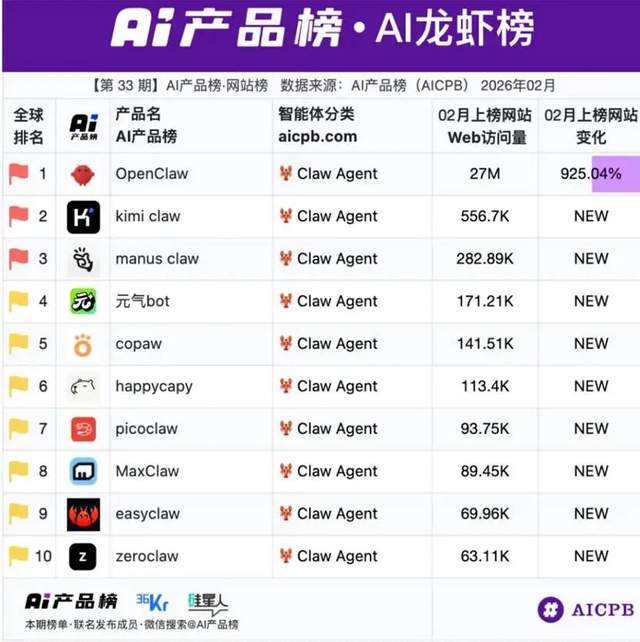
This is not a coincidence but a natural result of cognitive leadership. When the tide surged toward the new land of Agents, only those who built ships in advance could carry the most passengers.
02 Valuation Surge Logic: The Emergence of “Cost-Effectiveness”
If the “lobster craze” proved the correctness of the technical path, then the capital’s pursuit proved the viability of the business model. The three rounds of financing in three months can be seen as a collective correction and urgent stockpiling by the primary market for Kimi.
Previously, the market spotlight was more focused on companies like Zhipu and MiniMax, which were preparing for IPOs and received high attention and valuations due to their listing expectations. Kimi, due to its non-public status, had its true value underestimated or simplified for comparison.
However, the IPO processes of Zhipu and MiniMax have actually established new valuation anchors for the industry. In the Hong Kong market, competitors Zhipu and MiniMax have recently seen trading valuations between $34 billion and $45 billion.
This recognition of cost-effectiveness was ignited by impressive commercial data. After the launch of Kimi Claw, its number of individual subscription users saw exponential growth. Data from global payment giant Stripe revealed this explosive potential: the number of payment orders in January increased by 8,280% month-on-month, followed by another 123.8% increase in February, propelling it into the top ten of Stripe’s global rankings.
Even more astonishingly, Kimi’s revenue in just 20 days since the end of January exceeded its total revenue for the entire year of 2025. More notably, the revenue structure has changed: after the release of K2.5, Kimi’s overseas revenue has surpassed its domestic revenue, indicating that its commercialization has begun to participate in global competition.
Similarweb data shows that Kimi’s overseas API open platform website saw daily average visits increase by 10-20 times after the release of K2.5. In February, the traffic to kimi.com also reached a historical peak, with visits totaling 120 million in the past three months.
From a professional valuation perspective, this data supports the surge in valuation. The mainstream view in the market is that for AI large model companies, traditional internet valuation frameworks cannot be applied; instead, they should be re-priced around core indicators like ARR growth and Token usage growth.
Taking Kimi as an example, its revenue exceeding the total for the year in just 20 days since the end of January indicates a revenue growth rate of at least 18 times this year; according to OpenRouter data, the usage of the Kimi 2.5 model has consistently ranked among the top three this month, with a monthly growth rate of 67%, making it one of the fastest-growing models in the country. Even a simple calculation shows that its annual revenue and Token usage growth multiples far exceed 4 times, making a fourfold increase in valuation over three months not exaggerated.
In horizontal comparison, Zhipu and MiniMax, which are listed on the Hong Kong stock market, have market capitalizations of $34 billion to $45 billion, making Kimi’s $18 billion valuation appear relatively conservative.
For capital, this is a perfect investment narrative: technological leadership has been proven by industry hotspots, the business model has initially been validated with data support, overseas markets have confirmed growth potential, and the valuation still has room compared to already listed or IPO-bound peers. This convergence of favorable timing, location, and people has transformed Kimi from a “maybe invest” to a “must-invest” target in the primary market.
Three rounds of financing in three months, with a valuation soaring to $18 billion, may seem crazy, but it is actually an efficient pricing process as market information gradually becomes transparent. When the technical path, commercial data, and comparative valuations can all be clearly articulated, consensus among capital quickly forms.
03 The Urgency for Funding: Preparing for Intense Competition
From Kimi’s perspective, the willingness to complete financing intensively in such a short time, with the founder even describing it in a company-wide letter as “the financing amount exceeds that of most IPO fundraising and private placements of listed companies, believing we can raise even more from the primary market,” reveals a hidden motive: the level of competition in 2026 will be far more brutal than outsiders imagine.
The successful commercialization of the Agent model is a significant boon for the entire industry, but for individual companies, it means that the most brutal arms race has officially begun. Everyone sees the same future: Agents are the battleground.
Looking at OpenClaw as a reference, the current evolution speed of Agents can no longer be measured in months but in days. This evolution relies on continuous investment in several core capabilities: coding ability, which is the hand of the Agent executing tasks and must be sufficiently agile; multimodal capability, which is the eye of the Agent observing the world and must be sufficiently clear; and infrastructure expenditure, which is the blood vessel of the Agent and must be sufficiently robust.
As Agent applications gradually enter productivity scenarios, Token consumption scales grow rapidly. Research from Zhongtai Securities, through specific assumptions (such as a user interaction Token coverage rate of 60%), established a quantitative model linking Token consumption to computing power requirements (measured in the number of H100 GPUs). The calculations suggest that an AI application with over 100 million daily active users may require the equivalent of 141,500 H100 GPUs daily.
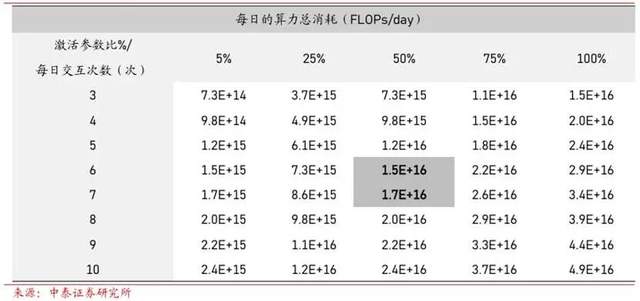
Recent data shows that China’s average daily Token consumption has risen from about 100 billion in early 2024 to over 30 trillion by mid-2025, reaching 180 trillion levels by February 2026.
This means that once Agents become the mainstream application form, the computing cost of models will no longer grow linearly but will leap exponentially. Any company wishing to remain in the game must be prepared with massive capital to pay this “computing tax.”
Yang Zhilin clarified the strategic goals for 2026 in an internal letter: through technological improvements and model scaling, the next-generation K3 model’s equivalent computing power should be enhanced by at least one order of magnitude, achieving parity with the world’s forefront at the pre-training level; vertically integrate model training and product experience to create differentiated capabilities for the K3 model; ultimately focus on the productization and commercialization of the intelligent agent itself, not aiming for absolute user numbers but pursuing the upper limit of intelligence to create greater productivity value, achieving an order of magnitude increase in revenue scale.
Kimi’s decision to continue financing at an $18 billion valuation, with a financing amount as high as $1 billion, is not merely to maintain the status quo but to stay ahead in the upcoming fierce competition. This is a preparation for survival, not just a blood transfusion for development.
04 The Eve of AI OS: From Lobsters to Windows, to a Trillion-Dollar Market
Observing Kimi’s financing rhythm within a broader industrial history reveals deeper discoveries.
The current OpenClaw and Agent craze is akin to the DOS operating system of the PC era. The industry is about to enter a critical period of “Windows” competition. In the DOS era, users needed to remember commands and write scripts to make computers work; in the “Windows” era, interaction became graphical and intuitive, allowing computers to enter thousands of households.
In the AI field, the current form of Agents is similar to that command-line DOS; it proves that machines can execute tasks. The next battlefield will be the AI OS. This AI OS must not only understand user commands but also manage underlying computing resources, handle multimodal input and output, and even become the core hub of future AI hardware.
From this perspective, Kimi’s accelerated financing and inflated valuation all become clear. The capital frenzy, on the surface, is chasing the equity of a star startup, but fundamentally reflects the intensifying internal competition within the industry and the positioning for future super entry points.
For Kimi, achieving an $18 billion valuation and completing three rounds of financing is merely a ticket to enter the next arena; it is far from guaranteeing victory. Because on the path to AI OS, the competitors are not only equally fierce startups but also giants with cloud resources and ecosystems. Tencent and ByteDance are rapidly building ecosystems around OpenClaw, attempting to lock user habits within their application systems.
This is a war over the next generation of human-computer interaction interfaces. Although Kimi is currently leading on the model side, it still faces significant challenges on the platform, ecosystem, and hardware sides. These three rounds of financing in three months are merely the first batch of ammunition prepared for this long war.
This weekend, when we see the news of Kimi’s valuation surge, we should not just be amazed but recognize the accelerating evolution of the AI world behind it. The leading technical path allowed it to stand out in the “lobster craze,” the explosive commercial data forced capital to reprice, and the anticipation of future Agent wars compelled it to stockpile resources at an unprecedented speed.
DOS has arrived, and Windows is on the way. This super war has just completed its preheating.
“I recognize the storm and am as excited as the sea,” for Kimi, for large models, for investors, and for everyone, this is largely the case.
Comments
Discussion is powered by Giscus (GitHub Discussions). Add
repo,repoID,category, andcategoryIDunder[params.comments.giscus]inhugo.tomlusing the values from the Giscus setup tool.