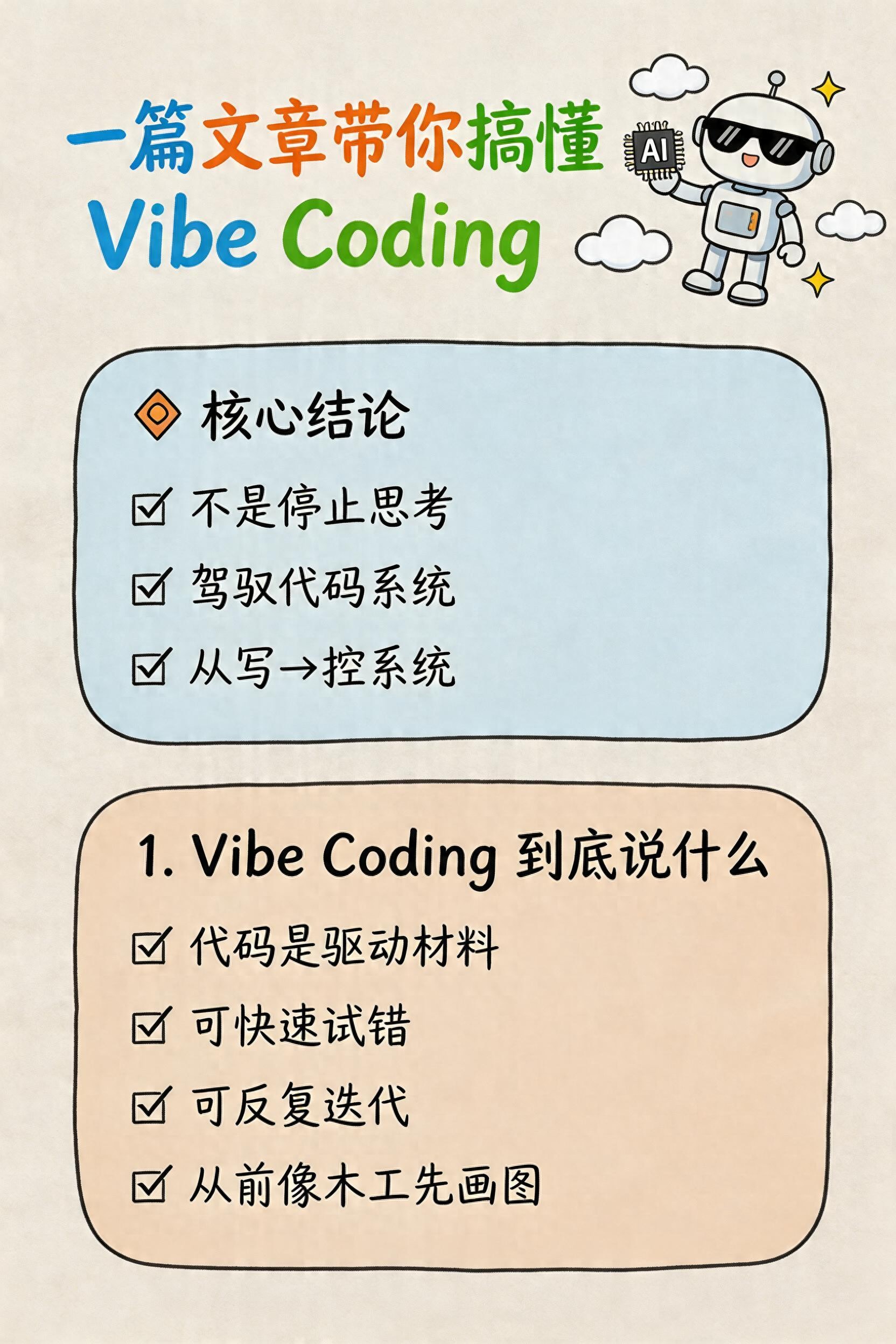
Recently, I came across a term: Vibe Coding.
If you haven’t heard of it, that’s normal. If you have but don’t quite understand it, that’s also normal.
It may sound like a joke, but it actually represents a new way of working that is taking shape.
Frankly speaking, once you get the hang of this approach, it will be hard to revert to the old rhythm of “first writing clear requirements, then writing clear code.”
Let’s start with the conclusion.
Vibe Coding does not mean you stop thinking.
It involves thinking at a higher level, moving you from “writing code” to “mastering a system that writes code.”
Sounds a bit abstract, right? Let’s break it down.
1. What is Vibe Coding?
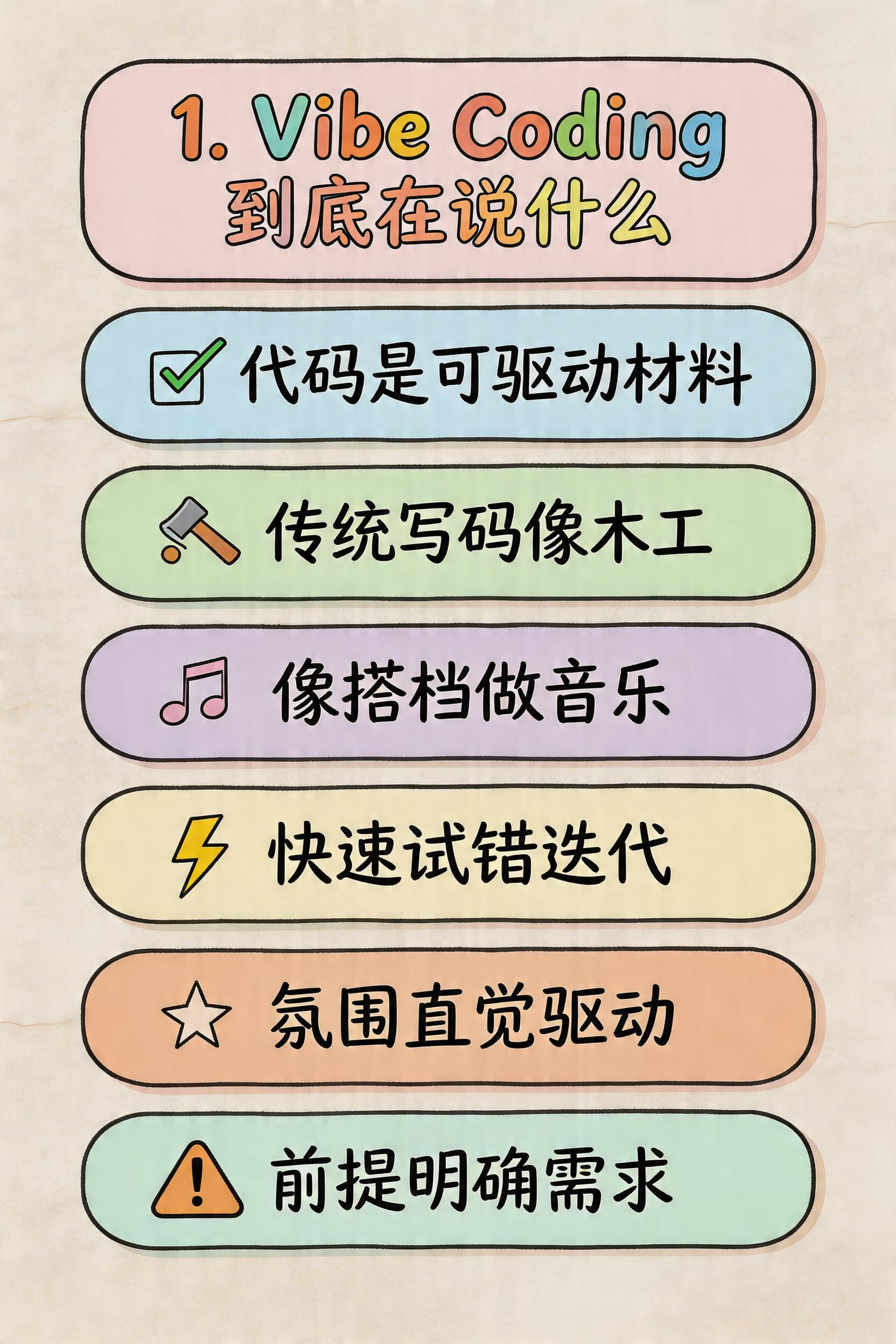
To explain it in simple terms, I would say:
You no longer view code as something you meticulously type out line by line.
Instead, you see code as a material that can be driven by language, quickly experimented with, and iteratively refined.
Previously, writing code was like carpentry: you would sketch a design, cut materials, and assemble them.
Vibe Coding resembles making music with a powerful partner. You provide a feeling, a direction, a rhythm, and it gives you a riff. You listen, make adjustments if needed, and continue if it feels right.
The focus is not on having a “perfect first version.”
The emphasis is on “iterating quickly enough that you dare to experiment boldly.”
That’s why it’s called vibe.
You drive iterations with atmosphere, intuition, and a sense of purpose, rather than a meticulously detailed specification document.
This may sound like slacking off, but the premise is actually more demanding.
You must understand what you want more deeply.
You need to judge what is right more effectively.
You must translate a vague feeling into executable constraints.
2. How is it Different from “Letting AI Write Code”?
Many people might think that Vibe Coding is just what everyone has been doing in the era of Copilot.
Not entirely.
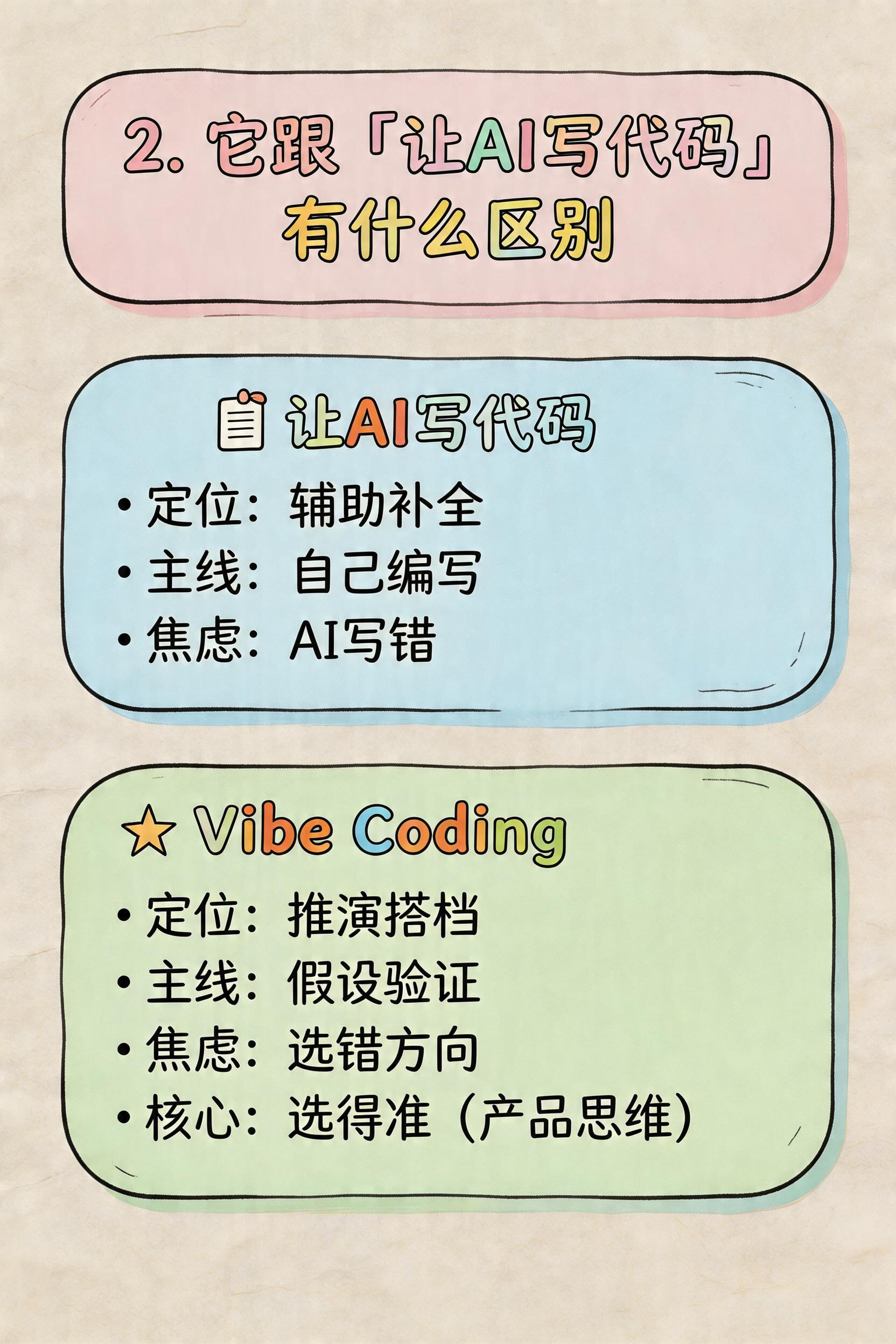
“Letting AI write code” is more like using AI as an autocomplete tool, where you still write the main lines and AI helps you save time.
Vibe Coding, on the other hand, treats AI as a partner that helps you explore solutions, where your main task is to “constantly propose hypotheses and quickly validate them.”
The mindset difference is significant.
The former’s anxiety lies in whether AI will make mistakes.
The latter’s anxiety is whether you are choosing the wrong direction.
Thus, the core capability of Vibe Coding is not about writing quickly.
It’s about making the right choices.
You need to swiftly determine which of three seemingly viable implementations is more stable, cost-effective, and less likely to fail in two weeks.
This is essentially a projection of product thinking onto the coding level.
3. What Does a Typical Vibe Coding Workflow Look Like?
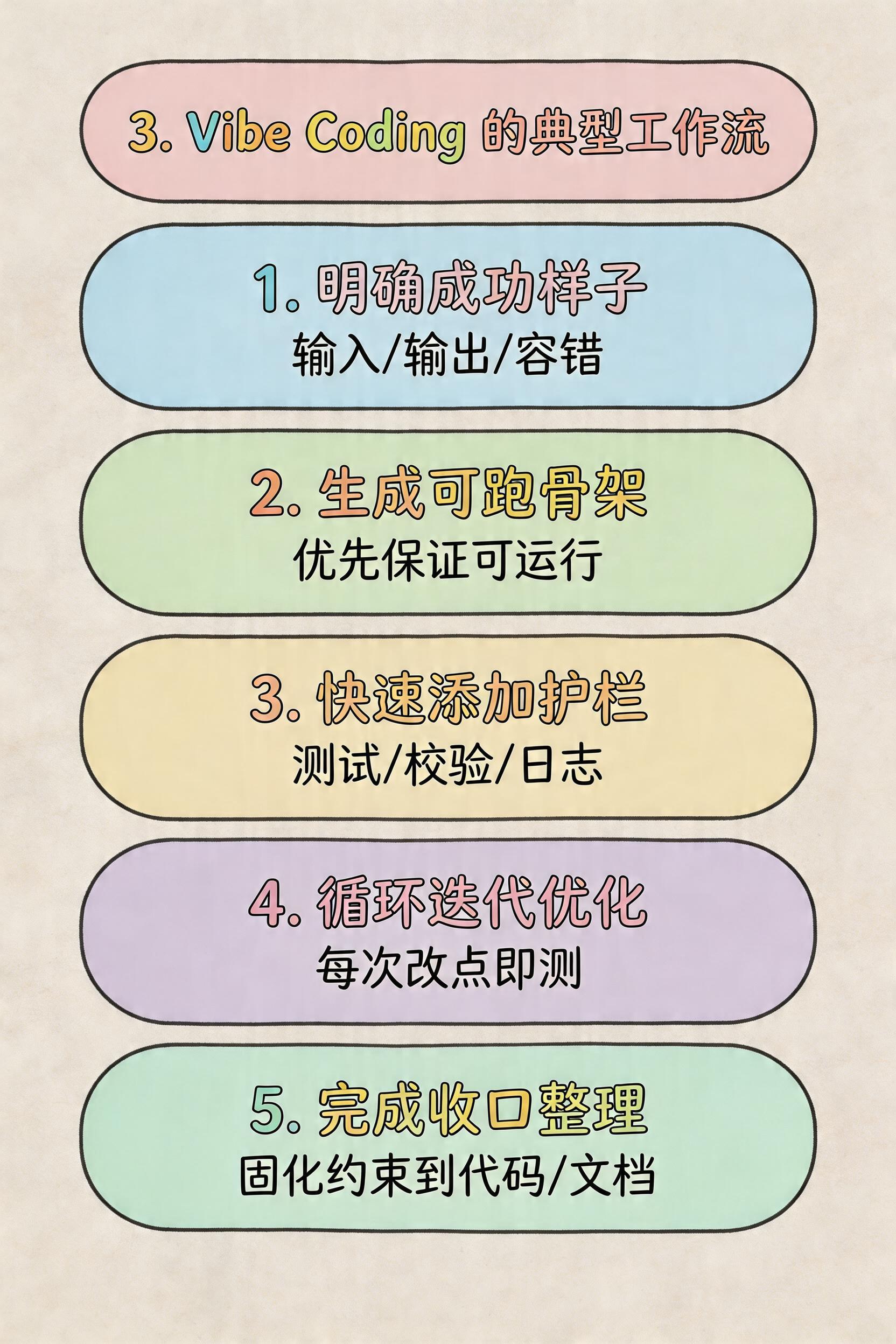
I’ve broken it down into a process you can try today.
The first step is to clarify your goals.
This is not about writing a clear requirements document, but rather articulating what “success looks like.” For example, if you need a script, define the input, output, fault tolerance, and how to handle failures.
The second step is to let AI provide a runnable skeleton.
You start by having it build the framework without worrying about aesthetics. Getting it to run is the top priority.
The third step is to quickly add guardrails.
For instance, add a minimal test, input validation, and logging. Don’t wait until the end to add these; the later you do it, the more painful it becomes.
The fourth step is to iterate in cycles.
In each iteration, change only one aspect, run it immediately after. You’ll find that you are not just writing code; you are controlling a system that continuously approaches your goal.
The fifth step is to wrap up.
Wrapping up means bringing the vibe back. Document the implicit constraints you discovered along the way in the code, README, and parameters. Transform it from “you can use it” to “others can use it too.”
There’s a practical judgment here.
The most enjoyable phase of Vibe Coding is the first 80%.
The last 20% is often the hardest, dealing with edge cases, compatibility, deployment, documentation, and maintainability.
What truly sets you apart is your willingness to complete that last 20%.
4. Why is it Gaining Popularity?
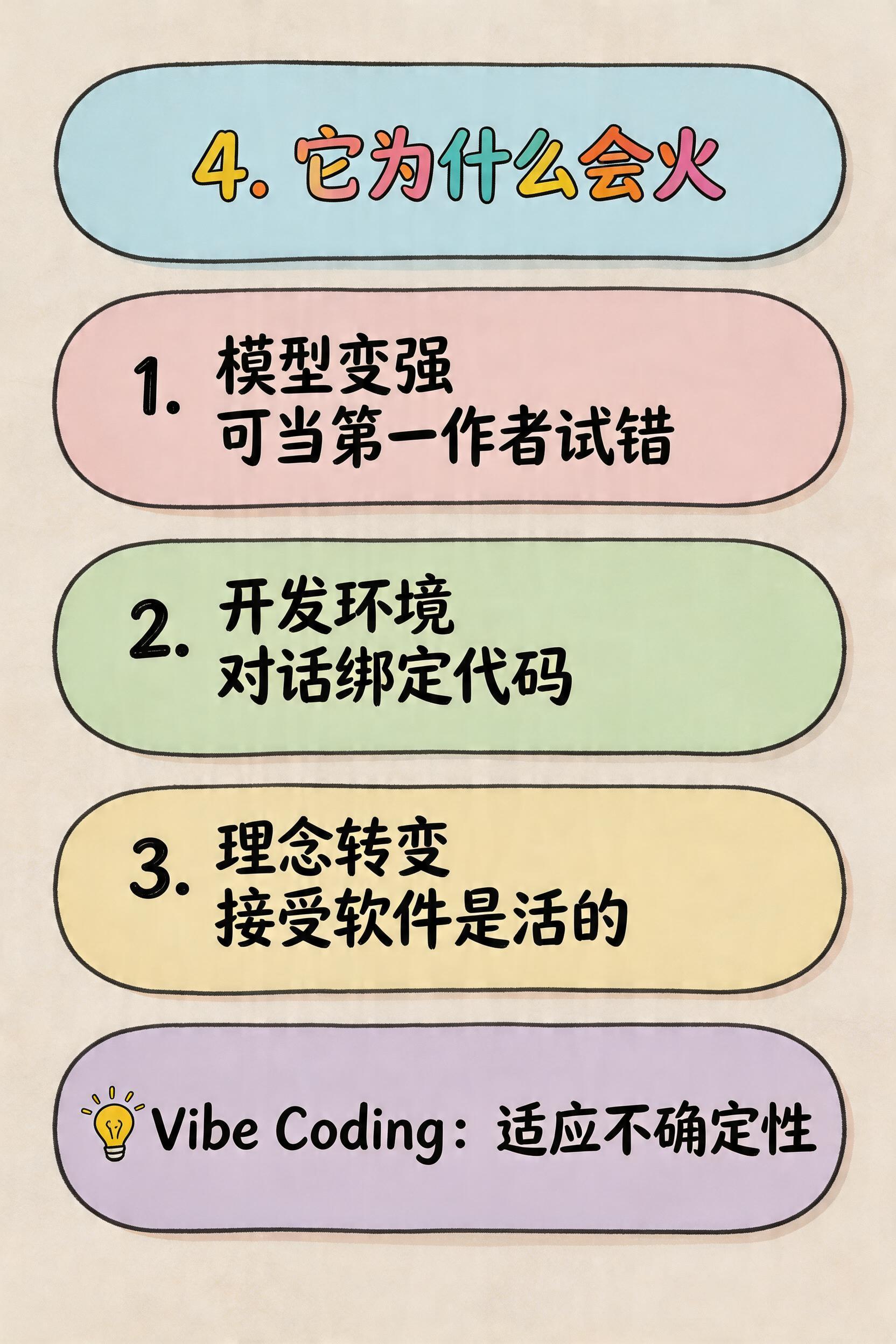
I believe there are three reasons.
First, models have become powerful enough that you can treat them as “primary authors” for experimentation, rather than as toys that require rework if they make mistakes.
Second, the development environment has changed. Tools like Cursor, Claude Code, and Codex have integrated “dialogue” with “code,” eliminating the need to switch contexts between IDE and chat windows, allowing your vibe to remain consistent.
Lastly, a deeper reason is that many people are starting to accept that “software is alive.”
Previously, we aimed for perfect designs from the start. Now, the correct approach for many projects is to get something running first, then refine and grow it.
Vibe Coding is a natural product of this era.
It is not just a technique but an adaptation to uncertainty.
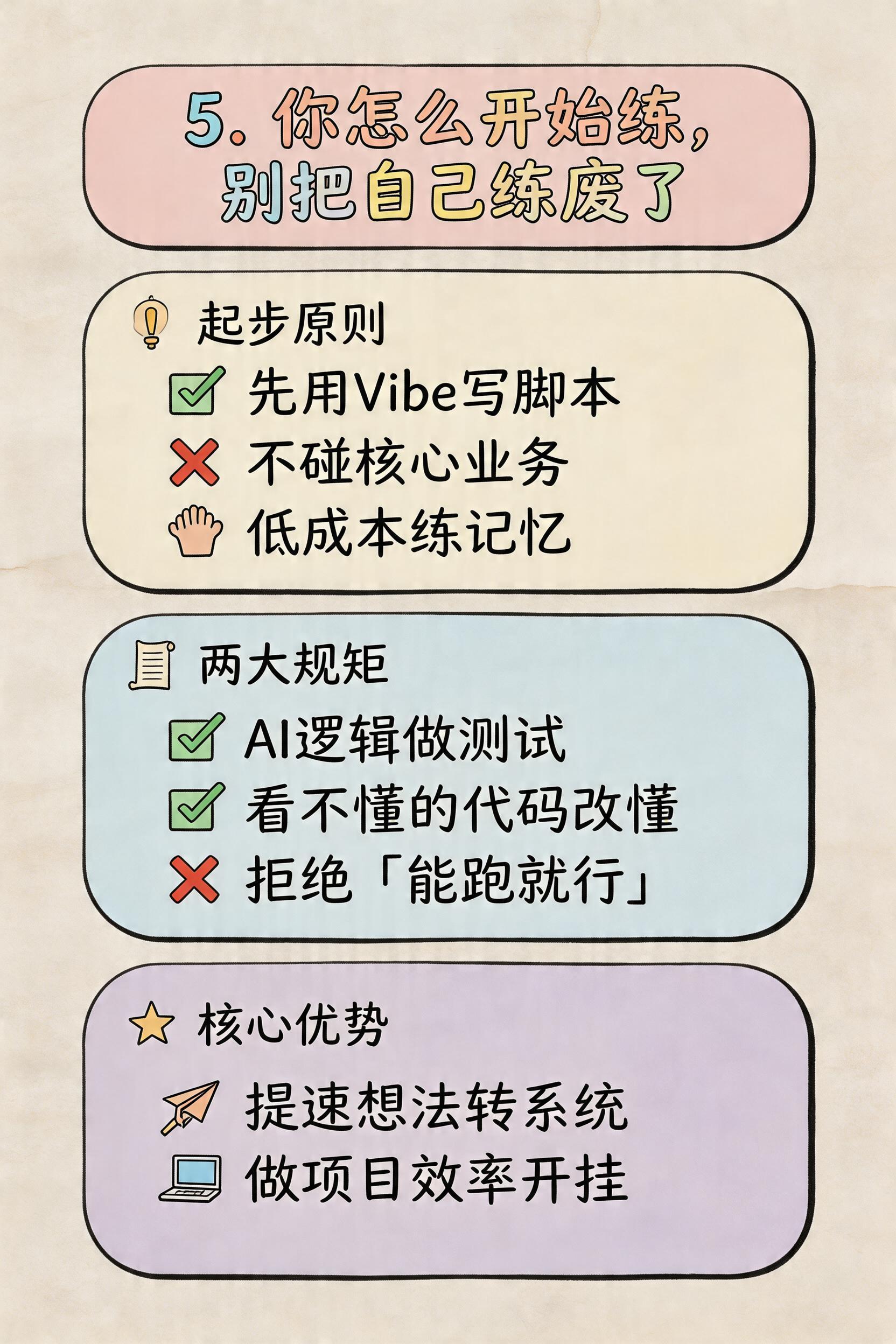
5. How to Start Practicing Without Burning Out
Honestly, I’ve stumbled in this area.
The most common pitfall is “vibing all night and then realizing you’ve written a bunch of unmaintainable code.”
So, I’ll give you a simple yet effective starting principle.
Begin by using Vibe Coding to write scripts, tools, or one-off automation tasks.
Don’t jump straight into using it for core business functions.
Because the failure cost of scripts is low, you can quickly build muscle memory.
Then you must establish two rules.
First, any key logic generated by AI must have a minimal test, even if it’s just three cases.
Second, any code you don’t understand must be modified until you comprehend it. Don’t rely on the mindset of “as long as it runs, it’s fine”; that pitfall will double back on you in the future.
You’ll find that Vibe Coding truly enhances not just the speed of writing code.
But rather, the speed at which you turn an idea into a runnable system.
Once you ramp up this speed, working on products, research, or automation will feel like you’re cheating.
Finally, I want to return to that initial term.
Vibe Coding is not about slacking off; it’s about leaving the parts humans excel at to them and handing over the parts machines excel at to machines.
Humans are responsible for direction, judgment, taste, and trade-offs.
Machines handle paving the way, experimenting, filling gaps, and heavy lifting.
What you need to do is become the one steering the wheel.
Comments
Discussion is powered by Giscus (GitHub Discussions). Add
repo,repoID,category, andcategoryIDunder[params.comments.giscus]inhugo.tomlusing the values from the Giscus setup tool.