Introduction
The case of AI curing cancer appears to be a victory for technological democratization, yet it reveals a brutal divide between the elite and technological privilege. This article, from the perspective of a product manager, deeply analyzes the resource monopolies and invisible barriers behind this sensational event, exposing the truths and profit rules in the AI and hard tech fields.
 Imagine a scenario where a programmer, without ever wielding a scalpel or spending a day in a lab, types a few lines of code one night, asks AI a few questions, and then—he cures late-stage cancer that even top oncologists could not handle.
This sounds like a poorly made Hollywood sci-fi story, but this is the real event that exploded in global media in March 2026. Sydney tech entrepreneur Paul Conyngham used an AI toolchain (including ChatGPT, AlphaFold, etc.) to design a personalized mRNA cancer vaccine for his dog Rosie, who was suffering from advanced mast cell cancer. Fifteen months later, this dog, initially given only 1 to 6 months to live, was chasing rabbits in the grass.
Thus, the global media frenzy began. Headlines in The Australian and viral posts on social media platforms sold the public a deadly illusion: “The era of AI for the masses has arrived; even if you are a biology novice, with an internet connection and ChatGPT, you can become a god.”
However, as an internet product manager who deals with traffic data, ROI, conversion rates, and system architecture daily, it would be a significant professional failure to indulge in this cheap celebration of “technology eliminating all barriers.”
Peeling away the media’s clickbait filter and dissecting the underlying code of this “miracle of life,” we see a starkly different and cold reality: this is not a fairy tale about zero-barrier technology, but a targeted explosion initiated by an elite class filled with technological privilege and resource monopolies.
The so-called “zero barrier” merely folds deep invisible thresholds of wealth and social capital worth “millions” into itself. Today, we will use the product manager’s perspective to thoroughly deconstruct this “feel-good story” and examine the harsh truths and profit rules hidden in the deep waters of AI and hard tech.

01 Pain Point Analysis: The Systemic Deadlock of “The World Suffers from Expensive Cures for Terminal Illnesses”
The driving force behind any phenomenon-level blockbuster product or event is the need to combat a deeply rooted and long-unmet user pain point. Before discussing why Conyngham decided to “handcraft” a vaccine, we must first understand the desperate “medical product ecosystem” he faced.
The “Standardization” Trap of Traditional Medicine
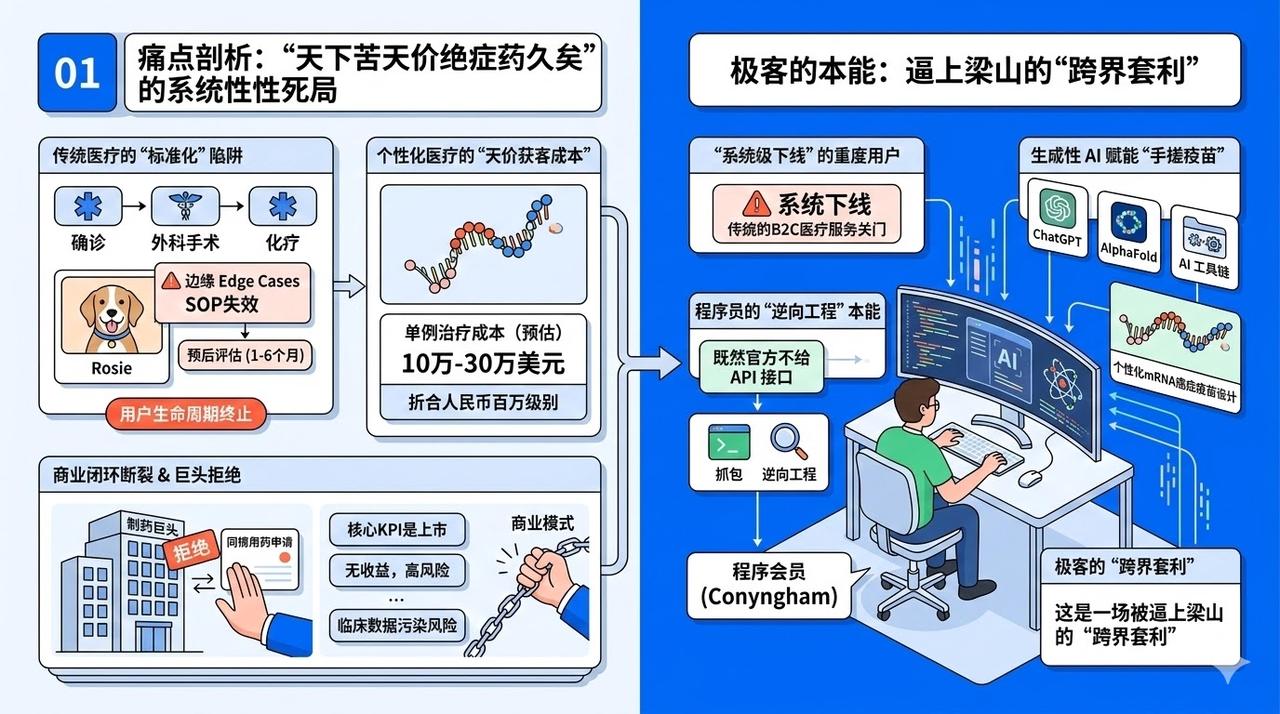
In the design logic of modern medical systems, the pursuit is for large samples and high success rates through “standard operating procedures (SOP).” For canine mast cell cancer (which accounts for 20% of all skin tumors), the standard treatment path is very clear: diagnosis -> surgical removal -> chemotherapy (such as vincristine).
However, the fatal bug in this system is that it cannot handle edge cases. When Rosie experienced treatment failure and tumor recurrence, entering late-stage cancer at the end of 2024, her “user lifecycle (LTV)” in the medical system was forcibly terminated, and her prognosis was directly assessed as terminal (1-6 months).
The “High Customer Acquisition Cost” of Personalized Medicine
When the standard path fails, is there a higher-level solution? Yes. Targeted immunotherapy drugs and the personalized mRNA cancer vaccines currently in development (such as the joint PD-1 inhibitor clinical trials by Moderna and Merck, which can reduce the risk of melanoma recurrence by 49%).
But there lies a sighing wall: the costs are extremely high and inaccessible to ordinary people.
- Breakdown of the Commercial Loop: Conyngham initially attempted to apply for “Compassionate Use” of targeted drugs but was ruthlessly rejected by pharmaceutical giants. Why? Because the core KPI of pharmaceutical companies is drug approval; giving a green light to a dog or an ordinary patient not only brings no profit but also poses high risks of legal and clinical data contamination.
- Sky-high R&D Costs: Even for humans, the estimated cost of such personalized mRNA vaccines can reach $100,000 to $300,000 (equivalent to millions in local currency).
Insights from a Product Perspective:
At this point, Conyngham’s situation is that of a heavy user who has encountered a “system-level offline.” When traditional B2C medical services are completely shut off, his instincts as a geek were triggered—if the official API is not available, he would capture packets, reverse engineer, and write a plugin himself. This was a “cross-border arbitrage” forced upon him.
02 Reality Unveiled: The Targeted Explosion of “Technological Privilege”
The media loves to shape narratives of “grassroots success” because it best harvests traffic. But with a little user persona investigation, one would find that calling Conyngham an “ordinary person” is the greatest misunderstanding of those three words.
Behind the celebration packaged as “a few dollars subscription to ChatGPT can cure cancer” is a severely folded “million-level” invisible wealth and barrier.
Cognitive Wealth: Interdisciplinary Computational Power That Cannot Be Replaced by GPT
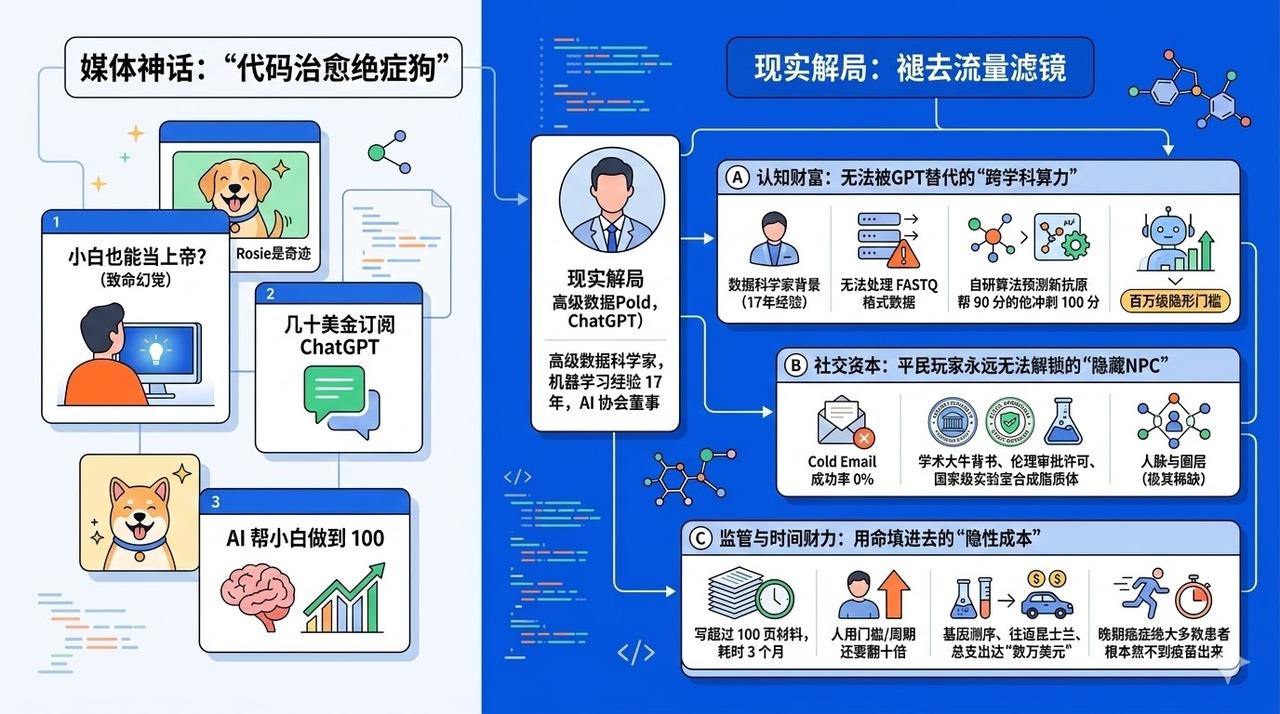
The media claims he “lacks a biology background,” but that does not mean he is a novice. The reality is: he has 17 years of experience as a machine learning and data scientist and is a board member of the Australian Data Science and AI Association.
Throughout the vaccine development process:
- Data Cleaning Ability: Obtaining the raw sequencing data from the UNSW Genomics Centre (in FASTQ format), do you think you can directly feed it to ChatGPT? Large language models cannot process such vast unstructured data that requires strict mathematical validation.
- Algorithm Development Ability: In the mutation identification and new antigen prediction stages, Conyngham relied on self-developed machine learning algorithms for screening, which requires deep mathematical logic and programming skills. Conclusion: If an ordinary person’s cognitive base is 0, AI can help you reach 60; but Conyngham’s base is 90, and AI merely helped him reach 100. This “cognitive wealth” starts at hundreds of thousands of dollars in the Silicon Valley recruitment market.
Social Capital: The “Hidden NPC” Ordinary Players Can Never Unlock
Let’s look at the key milestones in the timeline of Rosie’s vaccine and who supported them:
- Gene Sequencing: UNSW Ramaciotti Centre.
- Ethical Approval: Professor Rachel Allavena from the University of Queensland’s Veterinary School (one of the few researchers in Australia with ethical permission for canine immunotherapy experiments).
- Vaccine Preparation: Professor Páll Thordarson’s team at the UNSW RNA Institute. One must ask, what is the success rate for an ordinary person sending a “Cold Email” to these academic giants, asking them to conduct gene sequencing for their dog, navigate ethical approval, and utilize a national-level laboratory to synthesize lipid nanoparticles? It is absolute 0%. The ability to mobilize top academic resources and have scholars willing to endorse you is an extremely scarce invisible wealth.
Regulatory and Time Financial Costs: The “Hidden Costs” Paid with Life
To pass ethical approval, Conyngham spent three months, working intensely every night, writing over 100 pages of application materials. Even the approval for experimental treatments in veterinary medicine is extremely strict; if it were for human use, the approval thresholds and cycles would multiply tenfold.
Additionally, gene sequencing, travel to and from the University of Queensland, and multiple clinical monitoring resulted in total expenses reportedly reaching “tens of thousands” of dollars. More cruelly, late-stage cancer does not wait; the six-month R&D cycle means that most patients will not survive to see the vaccine completed.
Insights from a Product Perspective:
This is an elite experiment initiated by a high-net-worth user (wealthy, free time, top technology, and high-level connections) that cannot be replicated. The media has intentionally or unintentionally erased this “million-level” hidden cost, merely amplifying the visible label of “ChatGPT.” This narrative is not only unobjective but also extremely dangerous.
03 Underlying Logic: AI is an “Accelerator,” Not a “Creator”
As a mobile internet practitioner, we need to establish a deeper cognitive framework: in the field of biomedicine, where it belongs to “hard atoms,” what are the real boundaries of AI (bits)?
By dissecting Conyngham’s toolchain, we can clearly see what AI can and cannot do.
Knowledge Navigation Layer (Front-end): Defining ChatGPT’s Role
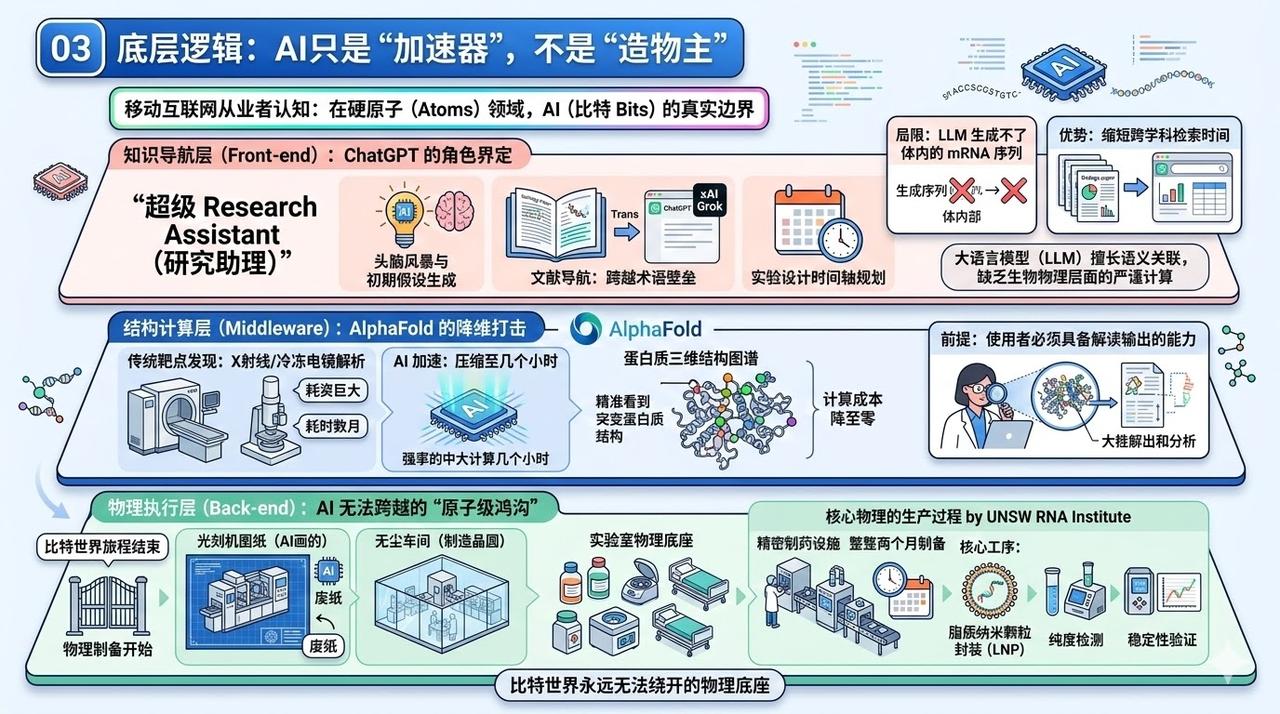
Many media headlines claim “ChatGPT cured the dog.” However, Conyngham himself has repeatedly clarified that he used ChatGPT (and later the xAI Grok model) merely for:
- Brainstorming and generating initial hypotheses.
- Navigating literature to break through the barrier of professional terminology (translating complex biological papers into terms understandable by data scientists).
- Planning the timeline for experimental design. Essentially, ChatGPT acts as a “super research assistant.” It significantly shortens the time for interdisciplinary knowledge retrieval, but it cannot generate an mRNA sequence that can be directly injected into the body. Large language models excel at establishing semantic connections but lack the rigorous computational ability required in biophysics.
Structural Computing Layer (Middleware): AlphaFold’s Dimensionality Reduction
The real “hardcore” role is played by AlphaFold, developed by DeepMind.
Traditional target discovery requires X-ray crystallography or cryo-electron microscopy to analyze the three-dimensional structure of proteins, which is costly and can take months. AlphaFold compresses this process to just a few hours, enabling Conyngham to precisely see the abnormal protein structures produced by Rosie’s tumor mutations.
Here, AI is an “accelerator,” reducing the computational costs of structural biology to zero. But the prerequisite remains: the user must possess the ability to interpret these 3D structure outputs.
Physical Execution Layer (Back-end): The “Atomic Gap” AI Cannot Cross
This is the most easily overlooked yet heaviest aspect of the entire myth.
When Conyngham utilized all AI capabilities to condense months of analysis into “half a page of mRNA sequence formula,” his journey in the digital world ended.
The subsequent physical preparation cannot be performed by any AI. The UNSW RNA Institute spent two full months, utilizing precision pharmaceutical-grade facilities to complete lipid nanoparticle encapsulation (LNP), purity testing, and stability verification.
This is akin to AI producing a perfect lithography machine blueprint; without a cleanroom to manufacture wafers, this blueprint is just a piece of waste paper. In the biomedical field, the laboratory’s reagent bottles, centrifuges, and clinical beds are the physical foundations that the bit world can never bypass.
04 Objective Reflection: Beware of Wild “Digital Hua Tuo” and Deadly Illusions
The video of Rosie running in the grass is indeed touching, but behind this emotion lurks enormous industry risks and ethical crises.
Survivor Bias and the N=1 Medical Scam
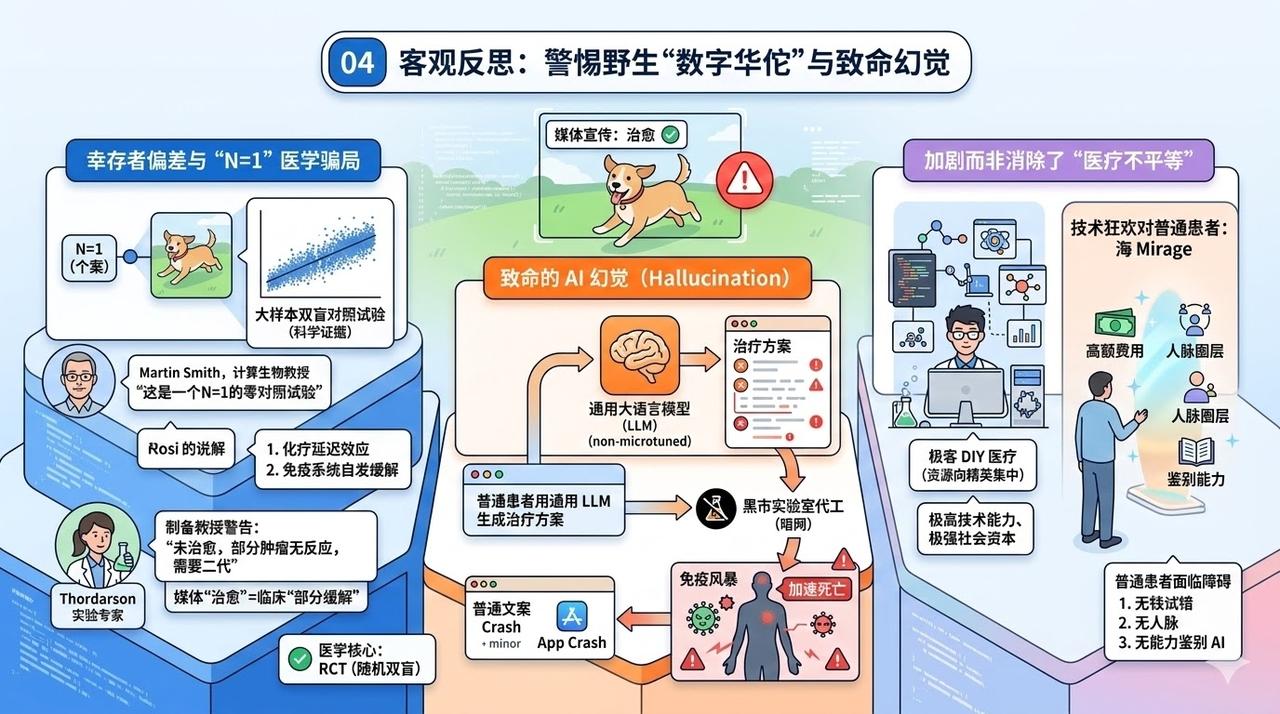
In medicine, individual cases without large sample randomized double-blind trials (RCT) have no statistical significance.
Martin Smith, an associate professor of computational biology at the University of Sydney, pointed out the most critical issue: “This is an N=1 zero-control trial.”
Did Rosie’s tumor shrink truly because of the mRNA vaccine? Could it be due to the delayed effects of previous chemotherapy drugs? Could it be spontaneous remission of the immune system? Without a control group, directly attributing causality to the AI-designed vaccine is an extremely unrigorous scientific attitude.
Even Professor Thordarson, who participated in the preparation, clearly warned: Rosie has not been cured; some tumors did not respond to the vaccine, and a second generation needs to be developed. The “cured” label used by the media can only barely be considered “partial remission” in clinical terms.
The Deadly AI Illusion
If a copywriting AI produces a hallucination, at most it results in a nonsensical press release; if a coding AI produces a hallucination, it may cause an app to crash.
But in the field of biomedicine, AI hallucinations can be fatal.
If ordinary patients blindly trust media hype and feed their genetic data into a generic language model that has not been medically fine-tuned, the AI could very well piece together a seemingly professional yet logically flawed “treatment plan” based on statistical probabilities from its corpus. If patients seek out black market laboratories based on this (which is not impossible on the dark web), the wrong targeting could trigger a systemic immune storm, leading to accelerated death.
Exacerbating Rather Than Eliminating “Medical Inequality”
The most ironic paradox is that personalized medicine was originally intended to save every unique life, and the introduction of AI technology was meant to lower barriers. Yet Rosie’s case proves that this “DIY-style” geek medicine has concentrated resources into a very small group of individuals with extremely high technical capabilities and strong social capital.
Ordinary people neither have the money to experiment nor the connections to reach university laboratories, nor the ability to discern AI outputs. This technological frenzy remains an elusive mirage for ordinary patients.
05 Breaking the Deadlock: How Mobile Internet Professionals Can Profit in the “AI + Hard Tech” Era
After dissecting this seemingly distant myth, what can we learn as mobile internet practitioners? Should we merely lament class solidification and technological barriers?
Absolutely not. In this era where even cancer can be attempted to be “hacked” by AI, the old product logic is collapsing, and new business models are being reshaped. Here are three practical methodologies for all product managers, operators, and entrepreneurs:
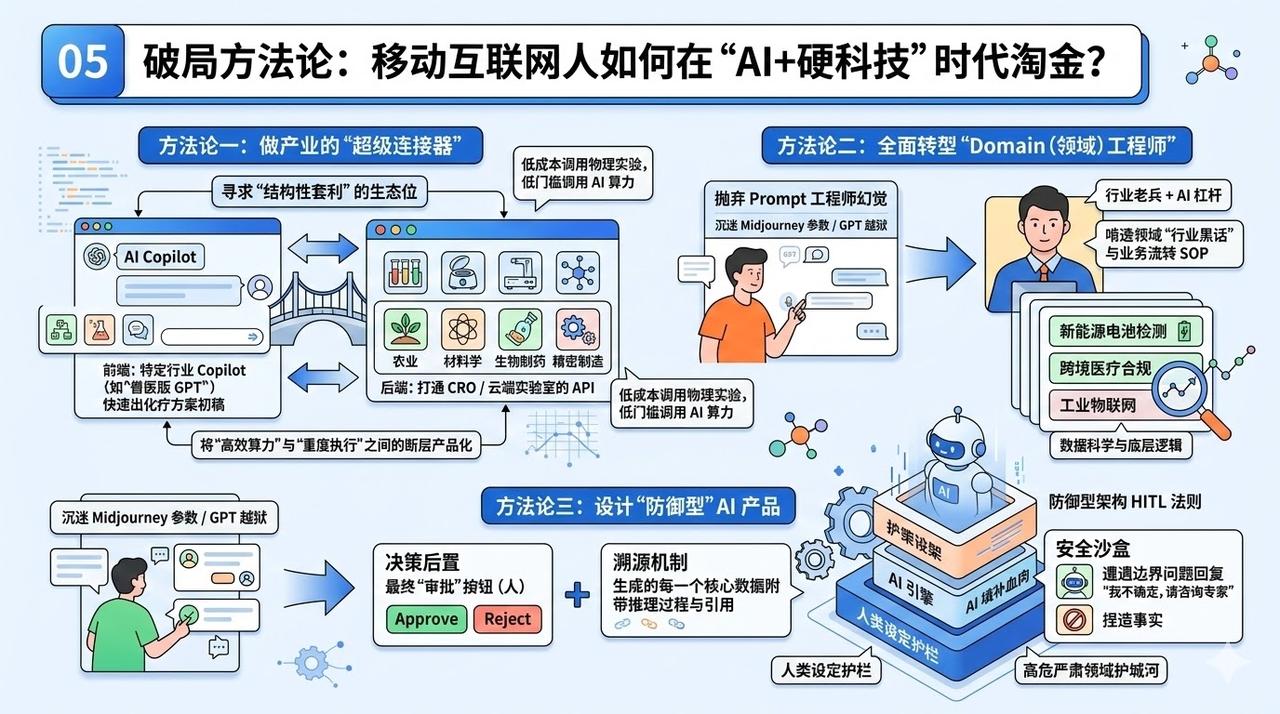
Methodology One: Find Ecological Niches for “Structural Arbitrage” and Become the Industry’s “Super Connector”
The biggest gap exposed by Rosie’s case is the severe disconnection between “efficient digital computation” and “heavy physical execution.” Conyngham filled this gap with his extraordinary connections.
Your opportunity lies in: productizing this gap.
Do not compete with generic large models, nor invest heavily in building physical laboratories. Be that “super connector.”
In agriculture, materials science, biopharmaceuticals, and precision manufacturing, there are many traditional veterans who do not understand AI and many AI geeks who do not understand industry know-how. If you can build a platform:
- Front-end: Provide compliant, industry-specific AI Copilots (for instance, a “veterinary version of GPT” to help doctors quickly draft personalized chemotherapy plans).
- Back-end: Connect CROs (Contract Research Organizations) and cloud laboratories (like Emerald Cloud Lab) with standardized APIs. Allow those who understand technology to access physical experiments at a very low cost, while those who understand the industry can access AI computation with minimal barriers. This “structural arbitrage” based on information asymmetry and resource scheduling is the battlefield where internet professionals excel.
Methodology Two: Abandon the “Prompt Engineer” Illusion and Fully Transform into a “Domain Engineer”
The era of “just knowing how to write prompts to control AI” is over. Conyngham succeeded not because he wrote good prompts, but because he understood data science and underlying logic; he knew at which points AI would produce nonsense.
Practical Advice:
If you are a product manager, immediately stop obsessing over complex parameters in Midjourney or jailbreak commands in GPT.
Choose a vertical field (like new energy battery testing, cross-border medical compliance, industrial IoT edge computing), and spend six months mastering the “industry jargon” and “business flow SOP” of that field.
When you possess deep Domain Knowledge and then use AI tools, you will outclass those who only know how to write fancy documents. The future core competitiveness will be: “Industry veterans + AI leverage.”
Methodology Three: Design “Defensive” AI Products to Build a High Trial-and-Error Moat
The risk in Rosie’s case lies in “hallucinations leading to death.” When launching AI products in the future, especially in high-risk fields like finance, healthcare, law, and education, your product architecture must shift from “All-in AI generation” to “human-set guardrails with AI filling in the details.”
Practical Standards (HITL Principle: Human-in-the-loop):
- Post-decision: AI should only compress information and provide options; the final “approval button (Approve/Reject)” must be given to qualified humans.
- Traceability Mechanism: Every core data/report generated by your AI product must include its reasoning process and knowledge base citation links. Just as Conyngham had to verify AlphaFold’s structures himself, your product must allow users to “trust.”
- Safety Sandbox: Set limits for AI. It is better to have it respond “I’m not sure; please consult an expert” when encountering boundary issues than to fabricate facts to please users.
Conclusion
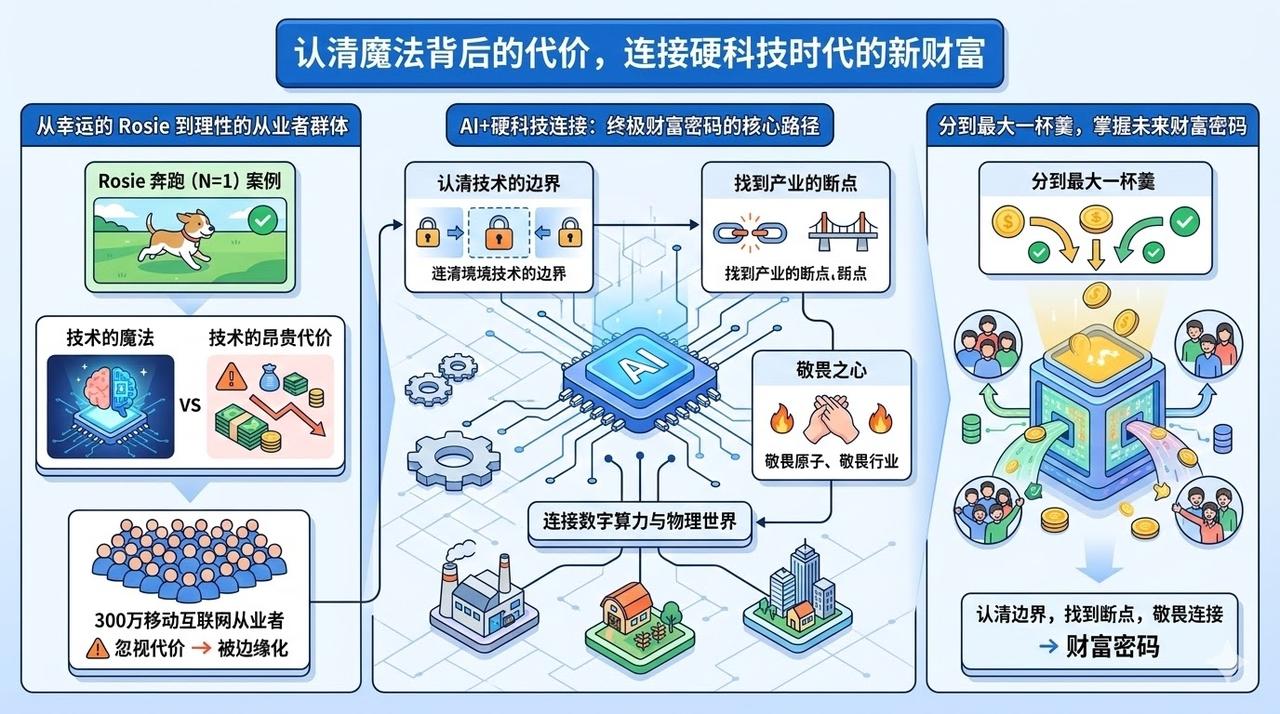
When Rosie runs in front of the camera, she is indeed a lucky dog. But for the 3 million mobile internet professionals, if we only see the magic of technology while ignoring the high costs behind it, we will be completely marginalized in this grand AI transformation.
Recognizing the boundaries of technology, finding the fractures in the industry, and connecting digital computation with the physical world with reverence is the ultimate wealth code we can share in the AI-native era.
Comments
Discussion is powered by Giscus (GitHub Discussions). Add
repo,repoID,category, andcategoryIDunder[params.comments.giscus]inhugo.tomlusing the values from the Giscus setup tool.